AO: #Olympus
QIC: @Nano
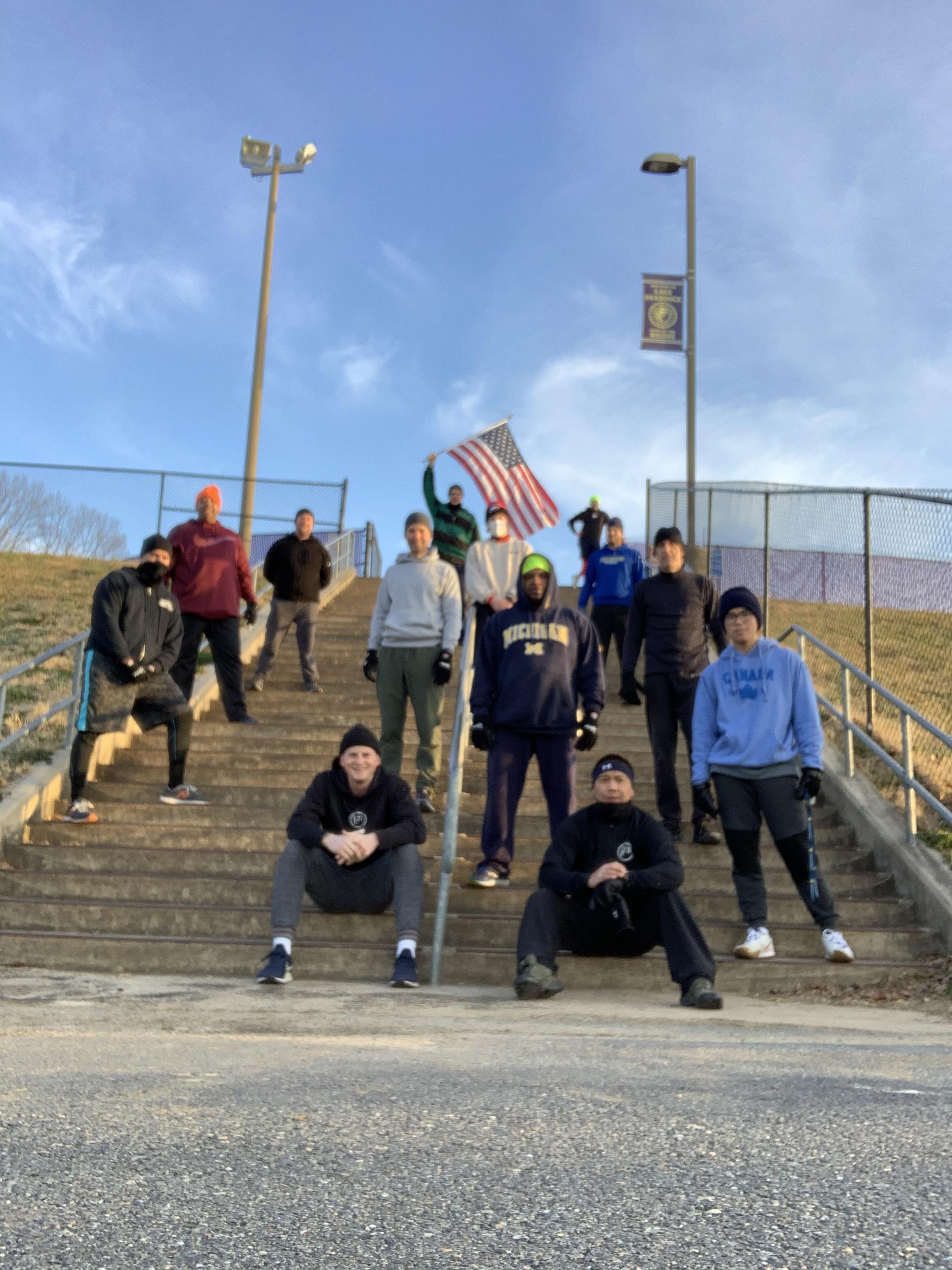
The PAX: Hightower, Yardsale, Wham-O, Choo Choo, Zeus, Monk, Vespa, Big Kahuna, Phish, Roddick, Pop Fly, and Rambler
WarmUp: Side Straddle Hop, Windmills, Willy Mayes Haze, Good Mornings, Downward Dogs
The Thang: To keep up with the Make America Burpee Again Challenge, the PAX lined up on the goal line for one burpee per yard. Every minute on the minute for 10 minutes we would burpee for ten yards and rest until the next minute began. It was tough be everyone made it to the end.
On to F3 Monopoly:
The board:The board consisted of 20 cones in a square surrounding the center circle of the football field. Each cone had a different property, railroad, or core utility. They were broken down as follows:
- Railroads
- Burke Railroad
- 25 Burpees to Own
- 50 Burpees if Owned
Braddock Railroad
- 25 Burpees to Own
- 50 Burpees if Owned
Springfield Railroad
- 25 Burpees to Own
- 50 Burpees if Owned
Alexandria Railroad
- 25 Burpees to Own
- 50 Burpees if Owned
Core Utilities (Cannot be owned)
- 100 Freddie Mercuries IC
- 100 Big Boi Sit-ups HC
- 100 Flutter Kicks IC
- 100 Little Baby Crunches IC
Blue Properties
- Shipplet Blvd
- 100 Side Straddle Hop IC to Own
- Rent (If Owned) 150
- Rent (1 House) 250
Old Keen Mill Rd
- 75 Windmills IC to Own
- Rent (If Owned) 150
- Rent (1 House) 200
Lee Chapel Rd
- 125 Shoulder Press to Own
- Rent (If Owned) 75
- Rent (1 House) 250
Red Properties
- Sydenstricker Rd
- 200 Air Squats HC to Own
- Rent (If Owned) 250
- Rent (1 House) 300
Etta Dr
- 50 Bonnie Blaires IC to Own
- Rent (If Owned) 75
- Rent (1 House) 125
Nanlee Dr
- 100 Lunges HC to Own
- Rent (If Owned) 150
- Rent (1 House) 200
Yellow Properties
- Lake Braddock Dr
- 80 yd Bear Crawl to Own
- Rent (If Owned) 120 yd
- Rent (1 House) 200 yd
Mt. Lookout Ct
- 80 yd Crab Walk to Own
- Rent (If Owned) 120 yd
- Rent (1 House) 200 yd
Dunleigh Dr
- 120 Calf Raises to Own
- Rent (If Owned) 120
- Rent (1 House) 200
Green Properties
- Rolling Rd
- 100 Hand Release Merkins HC to Own
- Rent (If Owned) 120
- Rent (1 House) 200
Tuttle Rd
- 80 yd Inch Worm to Own
- Rent (If Owned) 120 yd
- Rent (1 House) 200 yd
Braddock Rd
- 400 Yard Spring to Own
- Rent (If Owned) 600 yd
- Rent (1 House) 1600 yd
Game Play:
- Teams were selected with the goal of having about 4 on each team.
- Each team is given one die.
- Each team is given 12 game pieces.
- Each team is given 1 house piece.
- Each team starts at a different corner and they have their own die.
- At the same time, a member from each team rolls the die and the game begins.
- If they land on a property that is not owned:
- The team can buy it (see below).
- The team can choose not to purchase it and roll again.
- For “Core Utilities” these can’t be owned, but you must still pay the price.
- To own a property, the team COLLECTIVELY, must do the exercises listed on the property.
- Once completed, they place one of their game pieces into the cone to claim it.
- If they own all three properties of the same color, they automatically get to put one house down.
- Railroads can be owned, but they can’t have a house.
- If a property is owned:
- If you own it, you just roll again.
- If you don’t own it, pay the “If Owned” rent.
- If you don’t own it and it has a house, pay the “1 House” rent.
- There is no money in the game, instead, time is money!
All of the teams made it around the board multiple times, no houses were placed, but on the 3rd and 4th time around, most of the properties were owned so the numbers of exercises really started to rise!
Mary: We had about 5 minutes for some core which included LBCs, mountain climbers, and pickle pounders, to name a few.
COT: In Gary Keller’s book “The One Thing” it describes the two different ways we can approach the day. The first is the Entrepreneurial approach were we take on the tasks in the day naturally as they arise. This is comfortable as we know how to accomplish them, we can do them right away, and we productive because we are taking action. More over, we could be very skilled in these actives meaning we are doing the work at a very high level. However, as he notes in his book, are you doing things the best you can perform them, or the best they can be performed? If your task for the day is to chop wood, should you be saying “where’s my axe?” or “how can I get my hands on a chainsaw?” Finding the chainsaw, doing it the best way it can be done, is the Purposeful approach. It forces us to go beyond our current capabilities and find new methods or models to get things done. This often means we will feel unnatural and uncertain, forcing us outside our comfort zone. In the end however, this is the approach that leads us down the path of true mastery and helps us to achieve much much more. So, what activities are you bringing your hatchet to when you should be finding your chainsaw?
 F3 The Capital